
July 01, 2026
PQR vs WPS: what is the difference between the two documents?

This is one of the questions I get most from people starting out with welding documentation. WPS and PQR always appear together, they are required by the same codes (ASME IX, AWS D1.1, ISO 15614, Petrobras N-133) and in practice one is worthless without the other. But they are different documents, produced at different moments, with quite distinct functions.
WPS: the proposed procedure
The WPS (Welding Procedure Specification) describes how a weld is to be made. It is essentially the recipe: welding process (SMAW, GMAW, GTAW, FCAW, SAW and so on), consumable, amperage and voltage range, travel speed, position, preheat, interpass temperature and whether heat treatment follows.
Every WPS goes through two stages. First there is the preliminary WPS, the proposed procedure, with no test yet proving it works. Once qualified it becomes the final WPS, backed by the test results and released for production use.
PQR: proof that the recipe works
The PQR (Procedure Qualification Record) is the record of what actually happened when a welder ran that preliminary WPS on a test coupon. Where the WPS says what should be done, the PQR shows what was actually done: the parameters used during welding and the results of the tests the code requires - tensile, bend, impact, macrograph, dye penetrant, radiography, depending on the case.
You can sum it up like this: the WPS is the recipe, the PQR is the proof that it works.
How the two documents connect
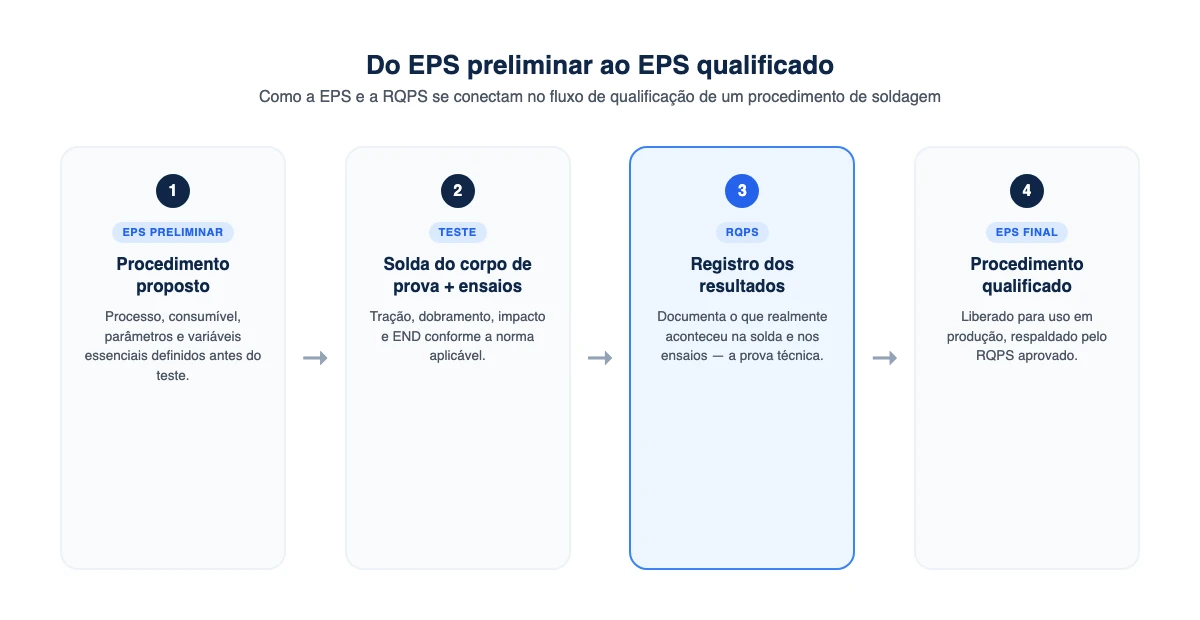
In practice the flow is always similar. Welding engineering writes a preliminary WPS with the proposed variables. A qualified welder welds a test coupon following that specification exactly. The coupon goes for the mechanical and non-destructive testing the code requires. If the results meet the acceptance criteria, they are consolidated into the PQR - and that acceptance is what turns the preliminary WPS into a final WPS, ready to go into production.
Without the PQR, the WPS remains just a proposal. There is no guarantee whatsoever that that combination of parameters actually delivers the required mechanical properties.
Why your company needs both documents
I have seen an audit stall simply because the company had the WPS filed away but could not find the PQR supporting it. And that is more common than it sounds: clients, certifying bodies and organisations such as Petrobras always ask for the two together, and a WPS without its matching PQR is a classic non-conformity.
There are practical reasons too. The PQR is the link between what was qualified in the laboratory and what is running in production - without it, there is no way to prove that today’s weld follows the same standard that was tested. It also serves as the basis for qualifying welders (ASME IX allows PQR test coupons to be used for that, which saves testing). And if a joint fails in service, it is the PQR that will say whether the procedure used was adequate - the kind of document nobody wants to need, but that makes all the difference when you do.
What invalidates a qualification
Each code defines a set of essential variables - process, consumable type, thickness range, position, preheat, type of current, among others. Change one of those variables outside the range qualified in the PQR and the WPS loses validity, even if the rest of the procedure is identical, and it has to be qualified again: new test coupon weld, new tests, new PQR.
That is why it is worth investing time in a well-thought-out preliminary WPS, covering the widest range the code allows. It substantially reduces the number of qualifications (and PQRs) the company will have to generate over time.
Mistakes I see frequently
- Using a WPS in production without checking that the PQR supporting it actually covers the thickness, material or position of what is being welded.
- Storing the PQR separately from the WPS, which complicates life when the client asks for both documents together in an audit.
- Swapping in an “equivalent” consumable without verifying that the change is still within the qualified essential variable range.
To close
WPS and PQR do not compete with each other and are not interchangeable - they are the two halves of the same qualification process. The WPS guides execution; the PQR proves the procedure is technically valid. Having both done well and well organised is what gets you through an audit without surprises, avoids rework and gives you a solid code foundation for growing into more demanding markets.
Need to qualify a welding procedure with the full documentation - preliminary WPS, test coupons, testing and final PQR - to ASME IX, AWS D1.1, ISO or Petrobras? Take a look at our WPS qualification service.