
July 12, 2026
Ferrite and austenite phase balance in duplex welding: how to avoid deleterious phase precipitation
The golden rule of duplex steels
The success of duplex stainless steels (including Lean Duplex S32101) rests on their balanced microstructure: roughly 50% ferrite and 50% austenite.
Ferrite acts as a robust matrix conferring high mechanical strength and protection against stress corrosion cracking. Austenite, arranged as islands or laths within that ferritic matrix, provides ductility, impact toughness and excellent pitting corrosion resistance.
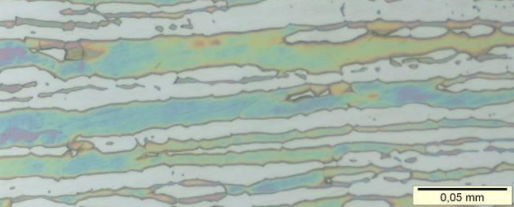
Below is a typical optical micrograph of the balance between the two phases in the base metal analysed, with the light elongated austenite laths (gamma phase) over the dark ferritic matrix (alpha phase):
Welding, however, is the Achilles heel of that microstructure. When the steel is heated above 1300 °C in the region next to the weld pool (the Heat Affected Zone, HAZ), it transforms 100% into ferrite. During cooling, austenite has to nucleate and grow again. If the thermal cycle is not controlled, the balance is destroyed.
The dangers of metallurgical imbalance
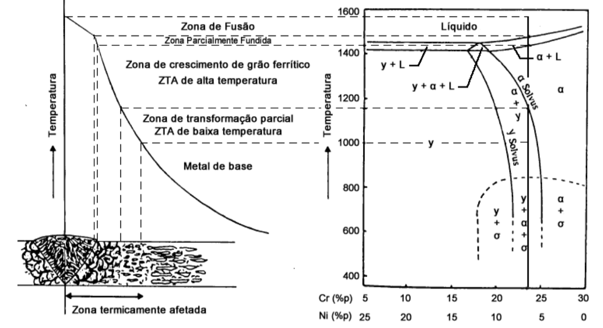
When the joint cools too quickly, or the heat input is inadequate, the transformation of ferrite into austenite is severely impaired. During the welding thermal cycle, the metallurgical transformations occurring in the HAZ follow the dynamic set out in the phase diagram below:
That creates two serious problems:
- Over-ferritisation (ferrite grain growth): the HAZ ends up with very high ferrite content (above 70%) and coarse grains. That drastically reduces weld toughness (making it brittle) and impairs corrosion resistance.
- Precipitation of deleterious phases and nitrides:
- Chromium nitrides (Cr₂N and CrN): because Lean Duplex has high nitrogen and low nickel content, the ferrite (which has very low nitrogen solubility at low temperatures) becomes supersaturated. Nitrogen combines with chromium in the steel, precipitating chromium nitrides at the grain boundaries. That depletes chromium around the precipitate, creating regions susceptible to corrosion (sensitisation).
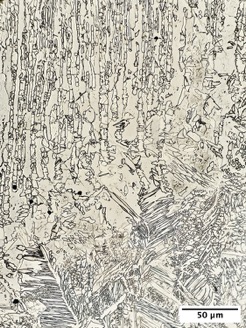
- Sigma phase (σ): precipitation of an iron- and chromium-rich intermetallic phase, extremely brittle and damaging. Below we can see the localised sites of sigma phase precipitation in the HAZ at high magnification under Scanning Electron Microscopy (SEM):
How do you secure the phase balance in welding?
To avoid embrittlement and maintain the corrosion resistance of welded Lean Duplex S32101 joints, welding engineering uses three fundamental strategies:
1. Use of an over-alloyed filler metal (ER2209)
Although the base metal is S32101 (Lean Duplex), welding should be carried out with ER2209 wire (conventional duplex). ER2209 has higher nickel content (around 9%), which acts as a powerful austenite promoter. That ensures the weld pool solidifies and cools with an adequate austenite content.
2. Heat input control
Heat input has to be rigorously controlled to keep the cooling rate in an ideal band. For Lean Duplex joints, heat input between 0.5 and 2.0 kJ/mm is recommended. Cooling that is too fast prevents austenite from forming; cooling that is too slow favours the precipitation of deleterious phases.
3. The beneficial effect of the Double-Sided TIG process (GTAW-DF)
Microstructural analysis by Scanning Electron Microscopy (SEM) showed that the Double-Sided TIG process (GTAW-DF) produced superior metallurgical behaviour in the HAZ:
- Because of the synchronised, controlled heating from both sides of the plate, there was enough time for nitrogen diffusion and for the ordered growth of intragranular and Widmanstätten austenite.
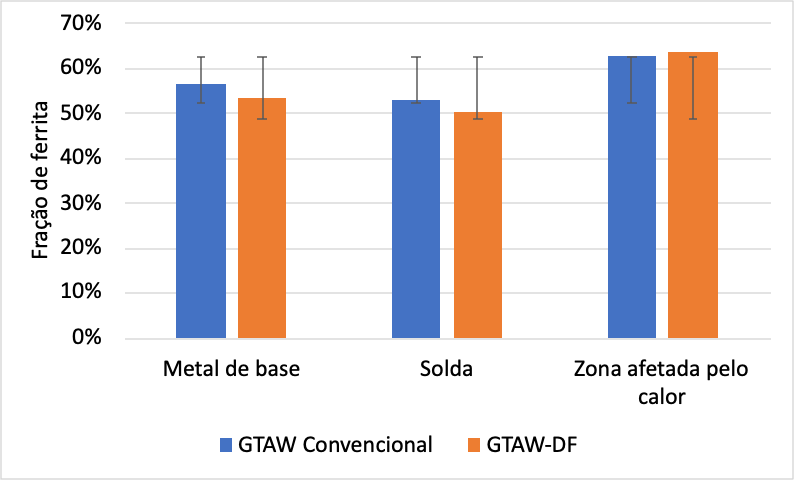
- The volumetric ferrite fraction in the HAZ stabilised at around 55% to 60%, staying within the acceptable code range (30% to 70%).
This stabilisation, and the comparison of ferrite fraction between the conventional and double-sided processes, can be seen in the chart below, confirming how effective the GTAW-DF process is at keeping the phase fractions balanced:
- The presence of chromium nitrides in the HAZ was minimised thanks to controlled cooling and the excellent gas shielding on both sides of the joint.
By understanding and mastering the metallurgical behaviour of duplex steels, quality engineering ensures that welded joints keep the structural performance and chemical resistance they were designed to deliver under severe industrial conditions.