
July 14, 2026
ASME IX F-Number and A-Number tables: a reference guide
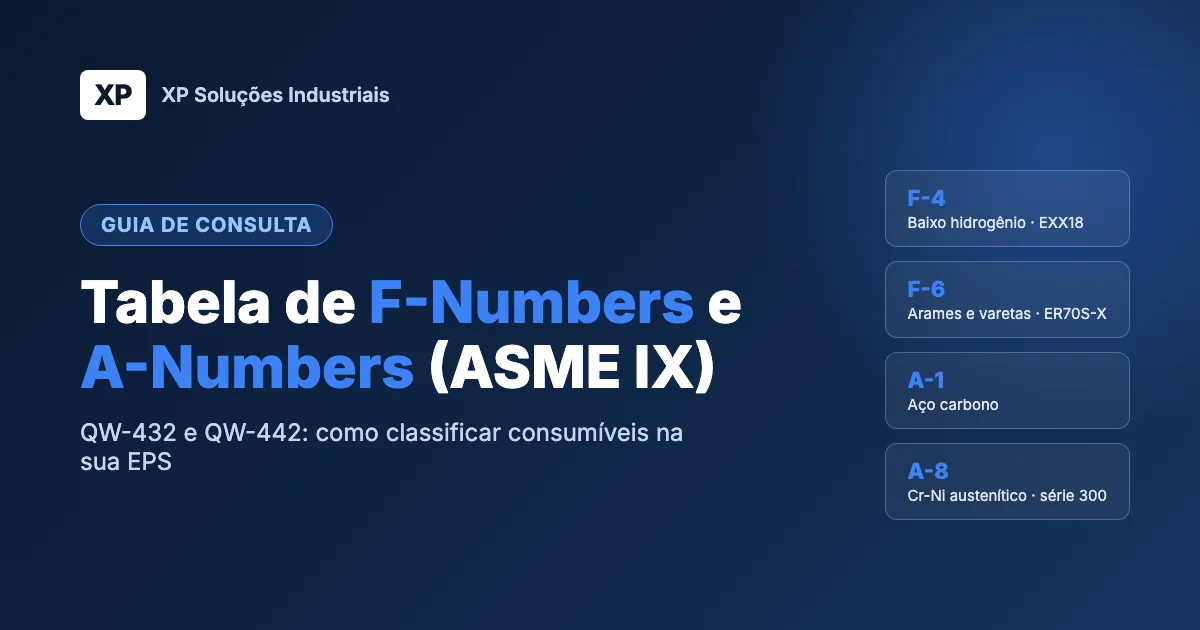
If the P-Number groups base metals, the F-Number and the A-Number do the same job on the consumable side. Together the three form the classification tripod of a WPS to ASME IX - and getting any one of them wrong means qualifying a range different from the one your production actually needs, or failing an audit.
This article summarises the two consumable groupings. If you are not yet comfortable with the P-Number concept, start with this article and with our interactive P-Number table.
What the F-Number is (QW-432)
The F-Number groups electrodes and filler rods by usability - the operational characteristic that determines the skill required of the welder. The logic is simple: someone who welds well with a cellulosic electrode (difficult) will probably weld well with a rutile one (easier), but the reverse is not true.
That is why the F-Number is an essential variable both for procedure qualification and for welder qualification.
Summary table of F-Numbers
| F-Number | Consumable group | Example AWS classifications |
|---|---|---|
| F-1 | High-deposition covered electrodes (iron powder) | EXX20, EXX24, EXX27, EXX28 |
| F-2 | Rutile covered electrodes | EXX12, EXX13, EXX14 |
| F-3 | Cellulosic covered electrodes | EXX10, EXX11 |
| F-4 | Basic covered electrodes (low hydrogen) | EXX15, EXX16, EXX18, EXX48 |
| F-5 | Stainless steel covered electrodes | E308-16, E316-15, E309-17 |
| F-6 | Wires and rods (solid, flux-cored and metal-cored) for steels | ER70S-X, E71T-X, ER308 |
| F-21 to F-26 | Aluminium and its alloys | ER4043, ER5356 |
| F-31 to F-37 | Copper and its alloys | ERCu, ERCuSi-A |
| F-41 to F-46 | Nickel and its alloys | ERNiCrMo-3, ENiCrFe-3 |
| F-51 to F-56 | Titanium and its alloys | ERTi-2, ERTi-5 |
| F-61 | Zirconium and its alloys | ERZr-2 |
| F-71 and F-72 | Hardfacing | - |
One detail that is worth real money in welder qualification: under QW-433, qualification with an F-4 electrode also covers F-1, F-2 and F-3 (subject to the conditions in the table, such as the use of a backing strip). Planning the test with the right consumable reduces the number of qualifications you need.
What the A-Number is (QW-442)
The A-Number classifies the chemical composition of the deposited weld metal in ferrous alloys. Where the F-Number looks at the operation, the A-Number looks at the metallurgical result of the deposit.
Summary table of A-Numbers
| A-Number | Deposited metal family |
|---|---|
| A-1 | Carbon steel |
| A-2 | Carbon-molybdenum steel |
| A-3 | Chromium-molybdenum steel (low Cr) |
| A-4 | Chromium-molybdenum steel (intermediate Cr) |
| A-5 | Chromium-molybdenum steel (high Cr) |
| A-6 | Martensitic chromium steel |
| A-7 | Ferritic chromium steel |
| A-8 | Austenitic chromium-nickel steel (300 series) |
| A-9 | Chromium-nickel steel (high alloy content) |
| A-10 | Nickel steel (up to ~4% Ni) |
| A-11 | Manganese-molybdenum steel |
| A-12 | Nickel-chromium-molybdenum steel |
The exact composition ranges for each A-Number are given in table QW-442 of the code - use the official values when classifying, particularly for deposits whose alloy content sits close to the boundary between families.
Where this lands in your WPS
In the QW-404 block (filler metal) of the WPS you declare the SFA specification, the AWS classification, the F-Number and the A-Number of the consumable. Those fields define part of the procedure’s qualified range: changing F-Number or A-Number will, as a rule, require requalification.
I have seen a WPS fail an audit over something trivial: the procedure qualified with ER70S-3 correctly declared “F-6 / A-1”, but production bought flux-cored wire of a different classification on the assumption that “wire is wire”. It is not - and the F/A-Number is what formalises that.
Put it into practice
Download our free WPS template in Excel to ASME IX 2025 ed. - bilingual, with the F-Number and A-Number fields already structured in the QW-404 block and a worked example.
And to master the complete writing and qualification process, from the P-Number to the PQR, take a look at the course Writing a WPS - ASME IX (2025 ed.) or talk to XP about WPS qualification as a service.