July 15, 2024
GTAW (TIG) welding process
What is TIG?
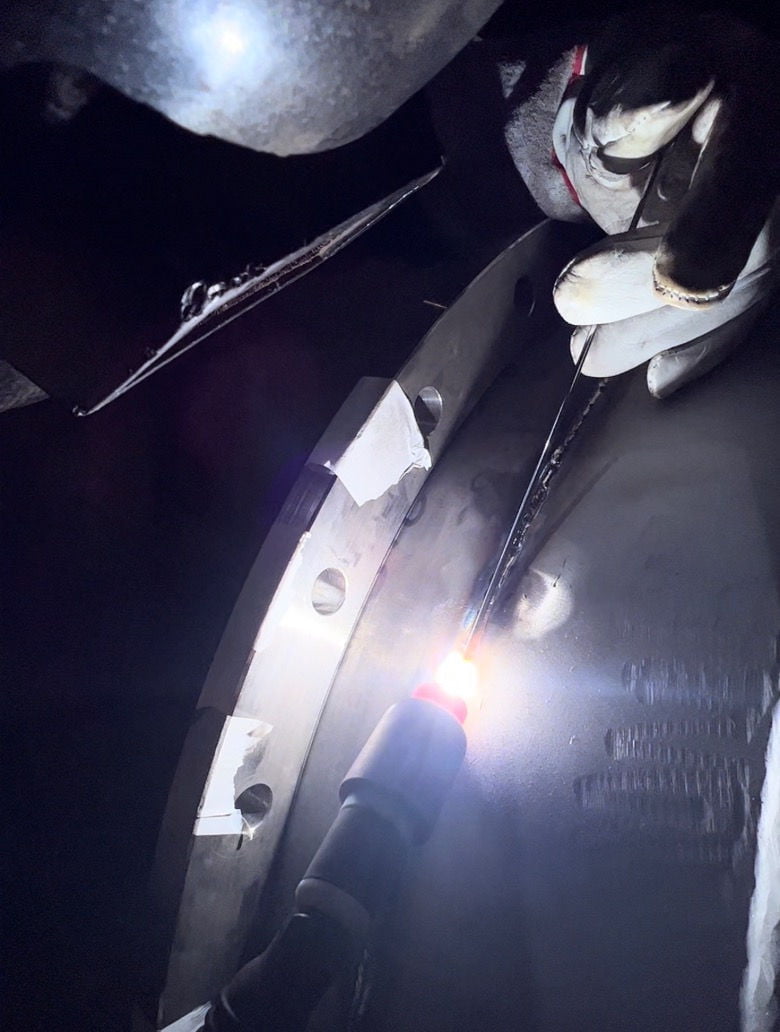
The TIG welding process (Tungsten Inert Gas), designated GTAW (Gas Tungsten Arc Welding) by the AWS (American Welding Society), is widely used for root passes and thin plate because it allows the energy applied during welding to be controlled very precisely.
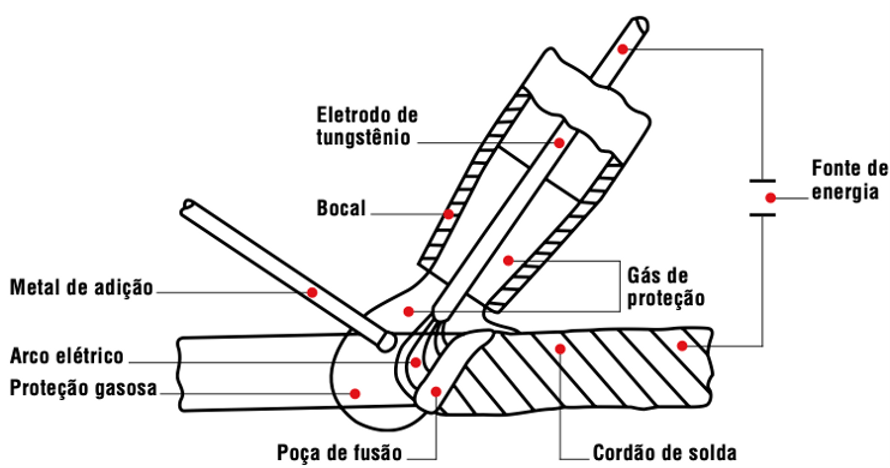
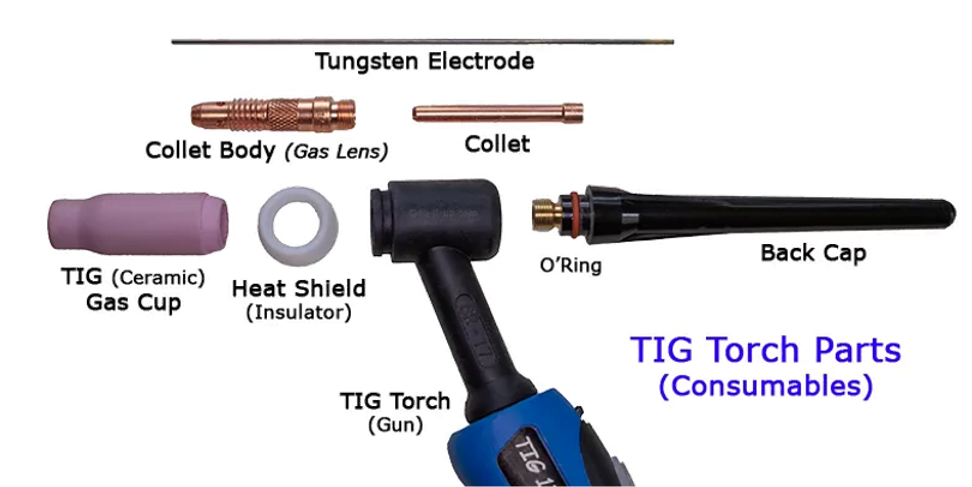
TIG is the welding process characterised by the use of a non-consumable tungsten electrode to establish the arc, shielded by an inert atmosphere supplied through the torch, as shown below. The electrode can be pure tungsten (chemical symbol ‘W’) or tungsten alloyed with other materials such as thorium (Th), lanthanum (La), cerium (Ce) or zirconium (Zr). In this process the arc is struck from the tungsten electrode, the weld pool is protected by the inert gas flow, and filler metal may be added (heterogeneous welding) as a rod (manual welding) or from a spool (mechanised/automated welding), or omitted entirely (autogenous welding). The figure below illustrates the TIG process.
Gas shielding
In this process inert gas shielding is needed to protect the weld pool, stabilise the arc and prevent oxidation and contamination of the tungsten electrode. If an active gas (CO2, for example) were used, the tungsten would be contaminated, causing arc instability and defects in the welded joint.
The shielding gases commonly used are argon (Ar), helium (He) or a mixture of the two.
Argon ends up being used in most applications because it is around five to eight times cheaper than helium and gives better weldability. Helium is used only in very special cases.
Other gases can also be added: when welding duplex stainless steels, 2 to 3% N2 may be added to the shielding gas composition to help weldability, promoting the formation of austenite.
Filler metal
The filler metal commonly used is the bare electrode, in rod form for manual work or as wire for mechanised or automated work.
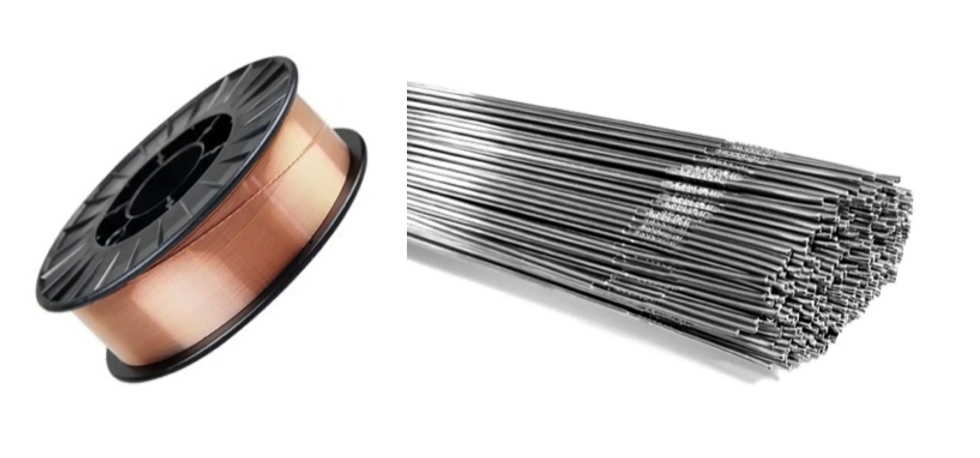
When continuous wire feed is used in mechanised or automated processes, a secondary current can be passed through the wire to help deposition and/or penetration. In that case the process is known as “hot wire”; where there is no secondary current it is called “cold wire”.
Equipment
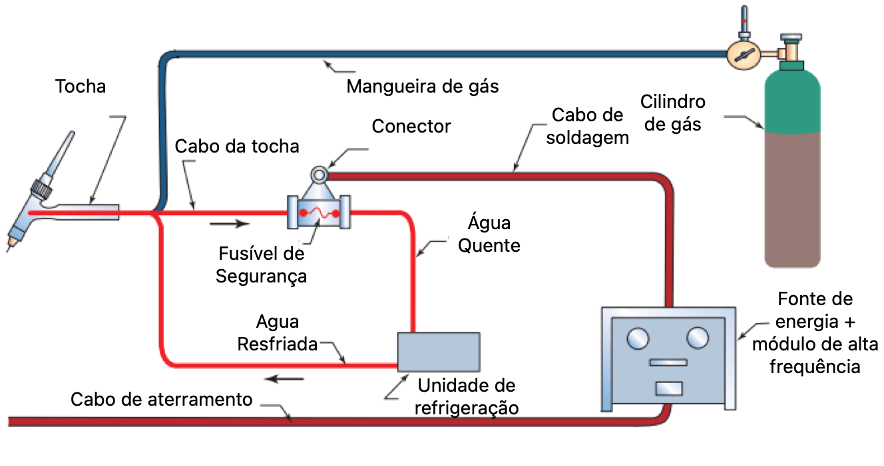
For normal applications, the basic equipment for manual TIG welding comprises a power source, a high-frequency ignitor (optional but highly recommended, to stabilise the arc without having to scratch the tungsten electrode on the workpiece), a gas supply, a cooled torch (because energy is concentrated at the tungsten, cooling the torch is necessary for good weldability), a torch cooling system and an earth cable, as shown below.
Tungsten electrode
Because the metal that strikes and stabilises the arc in GTAW (TIG) must not melt during welding, a tungsten electrode is used: tungsten melts at around 3400 °C, whereas steel and its alloys melt at close to 1500 °C.
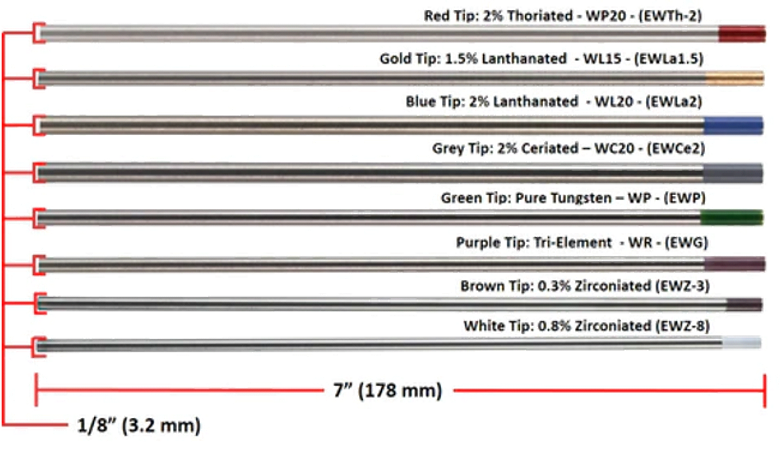
Besides pure tungsten, various alloys can be used to reduce the cost of this consumable, with combinations set out in AWS A5.12, which standardises the chemical composition of tungsten electrodes:
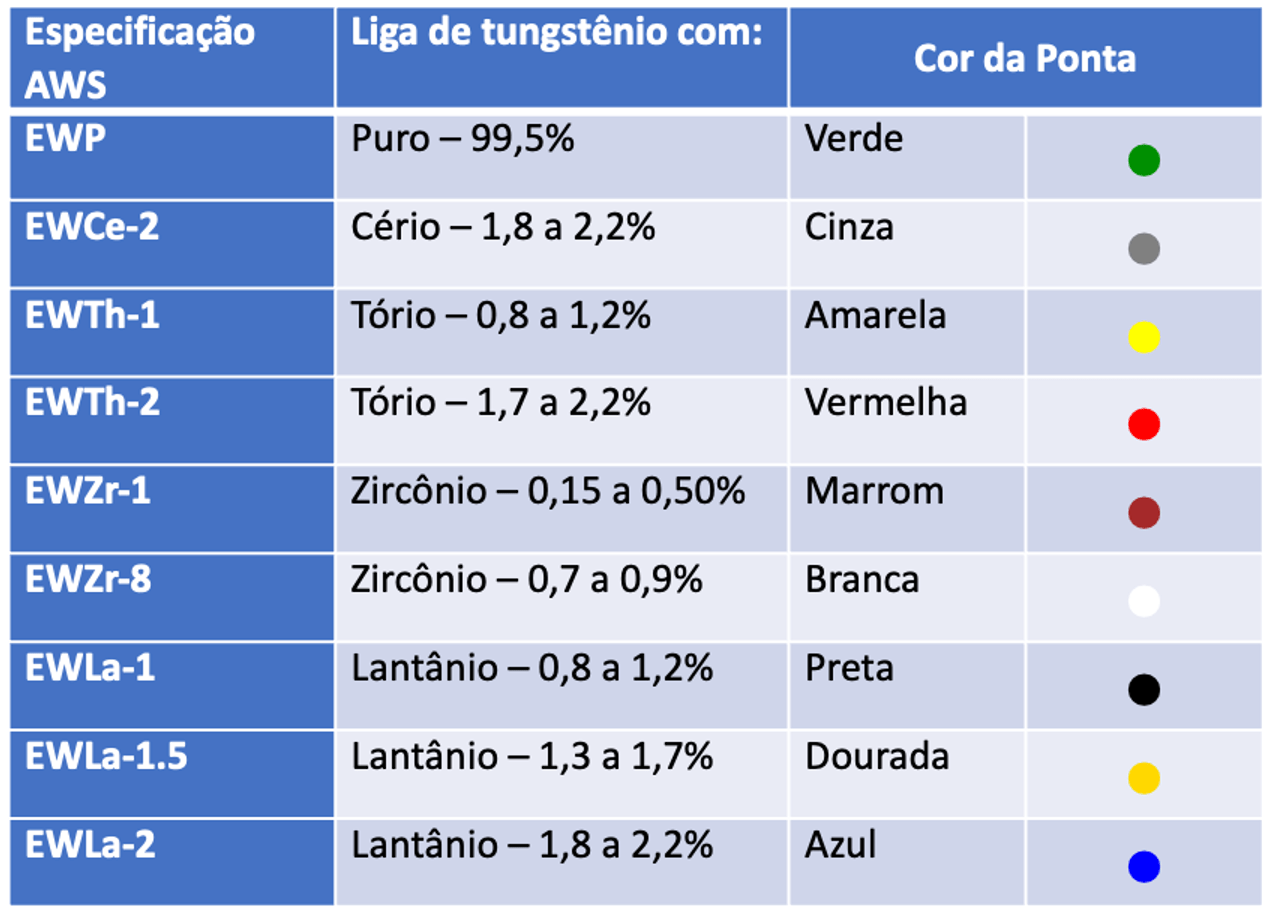
To identify the alloy of a tungsten electrode easily, the tips are marked with the colour standardised by the code, as shown below:
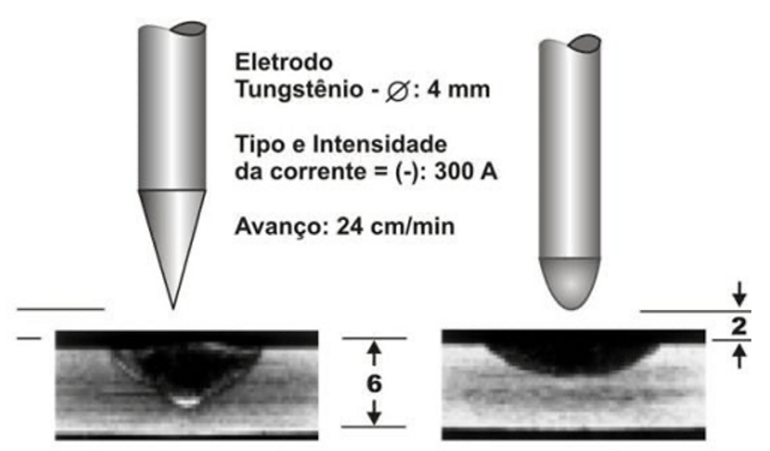
Grinding the tungsten correctly is essential for penetration and arc stability. As shown below, an electrode correctly ground to a 30° angle gives 3x greater penetration than one with a rounded tip, plus better control and arc stability.
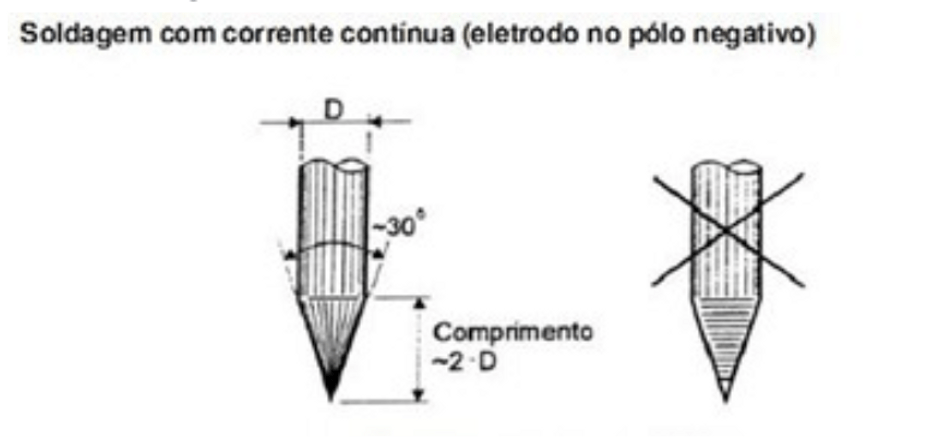
Depending on the direction the tungsten is ground, ceramic or acrylic cups can crack and the arc can wander and spread. It is therefore strongly recommended that grinding follows the length of the tungsten rather than across its diameter, as shown below:
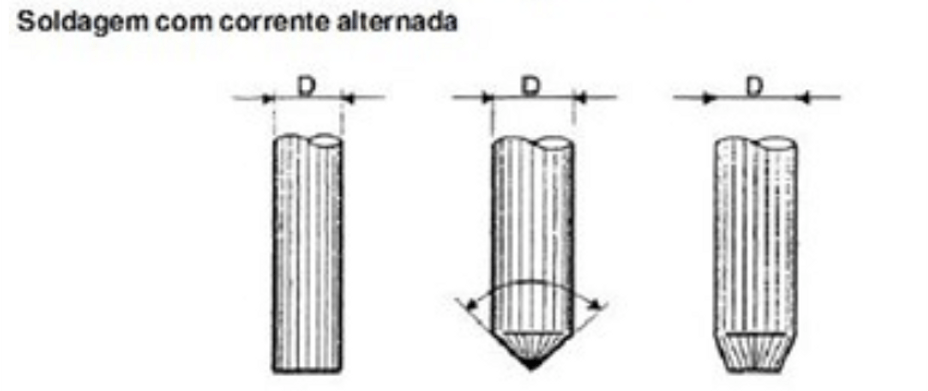
And where the application requires alternating current, such as aluminium welding, the tungsten must not be ground to a fine point: grind it at 60°, or blunt the tip, because with constant polarity reversal the tungsten can melt and transfer into the weld pool.
Applications
Because GTAW (TIG) has a very low deposition rate, around 0.5 kg per hour, and a low operating factor of 10% to 30% - there are many stops during welding to change the tungsten, grind the tungsten, change rods and move the welder from one point to another - it ends up being a process with very low productivity.
On the other hand, this process gives high control of the weld pool and of root penetration, so depending on the welder’s skill, joint quality for surface NDT (PT, MT) and volumetric NDT (UT and RT) is very high, the chance of discontinuities is very low, and it is also the process that welds most easily in all positions.
Based on those characteristics, the best applications for TIG welding in industry today are:
- Pipe root passes.
- Welding of small-diameter pipe.
- Welding of thin pipe and plate.
- It can be applied to practically every weldable material, but is mainly used on carbon steels, austenitic, duplex and super duplex stainless steels, nickel alloys, titanium alloys and aluminium alloys.
- In its mechanised/automated variation it is widely used for corrosion-resistant cladding inside pipe or on plate faces, as shown below: