
July 07, 2026
What are lean duplex stainless steels (S32101) and why are they changing the industry?
Introduction to duplex stainless steels
In the search for materials combining high mechanical strength with excellent corrosion resistance, duplex stainless steels have gained enormous prominence in capital goods, chemical, petrochemical and sugar-and-ethanol industries.
Unlike conventional steels (such as austenitic 304 and 316), duplex steels have a two-phase microstructure made up of roughly equal volume fractions of ferrite (alpha phase) and austenite (gamma phase). That balance (ideally 50%/50%, or 1:1) is what gives the material the best of both worlds:
- The high mechanical strength and stress corrosion cracking resistance of ferrite.
- The excellent toughness and formability of austenite.
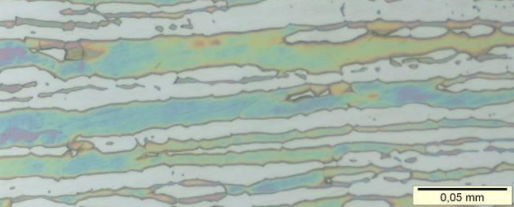
Below is the typical microstructure of a duplex stainless steel under optical microscopy, showing the balanced proportion between the ferrite (dark) and austenite (light) phases:
What is the “lean duplex” category (S32101)?
Conventional duplex steels (such as S32205) rely heavily on expensive alloying elements with volatile international market prices, mainly nickel (Ni) and molybdenum (Mo).
To address that economic problem, metallurgy developed the lean duplex category (such as grade UNS S32101). In these steels:
- Nickel content is drastically reduced (falling from ~5.5% to around 1.5% to 2.5%).
- Molybdenum is kept to minimal levels or eliminated.
- To compensate for the loss of those austenite-stabilising elements and maintain the phase balance, higher levels of manganese (Mn) and nitrogen (N) are added.
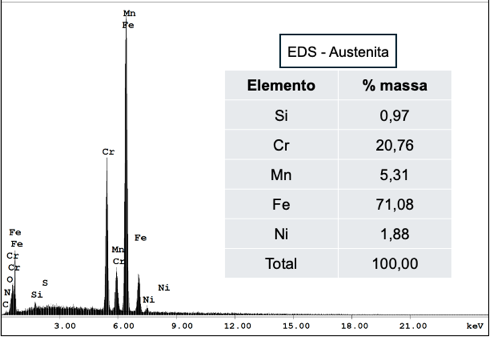
To understand the chemical distribution of each phase, we carried out Energy Dispersive Spectroscopy (EDS) analysis coupled to the SEM (Scanning Electron Microscope). Below is the spot analysis and elemental composition of the austenite phase (characterised by its higher nickel content):
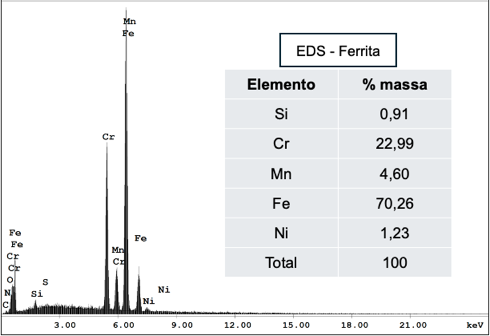
And next, the corresponding EDS analysis of the ferrite phase (with slightly higher chromium content and low nickel):
The result is a material that is highly competitive financially, with a far more stable market price, while retaining exceptional engineering properties.
Localised corrosion resistance: the PREN concept
To quantify and compare the pitting corrosion resistance (localised corrosion) of different stainless steel alloys, metallurgy uses the PREN index (Pitting Resistance Equivalent Number). The value is calculated theoretically from the contents of the main alloying elements, using the classic formula:
PREN = %Cr + 3.3 × %Mo + 16 × %N
For alloys with tungsten (W) additions, the PREW index is used:
PREW = %Cr + 3.3 × %Mo + 1.65 × %W + 16 × %N
Because lean duplex steels have very low nickel content and almost no molybdenum, their pitting corrosion resistance is lower than that of conventional duplex, super duplex and hyper duplex steels. It nonetheless remains superior to that of common austenitic steels.
The table below gives comparative values across the different classes of stainless steel:
| Alloy | Type / family | PREN range |
|---|---|---|
| 410 | Martensitic | 11.5 - 13.5 |
| 410S | Ferritic | 11.5 - 13.5 |
| 660 | Precipitation hardening | 16.8 - 21.0 |
| 304L | Austenitic | 17.5 - 21.1 |
| 2101 | Lean duplex | 24.5 - 28.6 |
| 2205 | Duplex | 34.1 - 37.8 |
| 2507 | Super duplex | 37.7 - 47.6 |
| 2707 | Hyper duplex | 44.0 - 53.5 |
(Note: although Lean Duplex UNS S32101 has lower corrosion resistance than conventional duplex or super duplex, it was designed specifically to fill the gap between conventional austenitics such as 304L and the duplex family, offering excellent mechanical and corrosion durability in moderate industrial atmospheres at a far more attractive and stable cost.)
Comparison of mechanical properties
The mechanical strength of Lean Duplex S32101 is about twice that of conventional austenitic stainless steels (such as AISI 304L). That allows industrial design engineers to specify pressure vessels, storage tanks and piping with significantly thinner walls, directly reducing structure weight and material purchase cost.
| Mechanical property | AISI 304L (austenitic) | UNS S32101 (lean duplex) |
|---|---|---|
| Yield strength (MPa) | ~200 | ~450 |
| Ultimate tensile strength (MPa) | ~700 | ~710 |
| Elongation (%) | ~45 | ~30 |
Recommended applications
Thanks to its excellent cost-benefit and structural properties, Lean Duplex S32101 is widely specified for:
- Sugar and ethanol plants: ethanol storage tanks, evaporators and juice piping.
- Water and wastewater treatment: structures and gates exposed to wet environments.
- Capital goods: heat exchangers and tanks for light chemical industry.
- Civil steel structures: bridges and walkways in coastal or aggressive industrial environments.
Understanding the metallurgy and behaviour of these steels is the first step to extracting maximum performance from them. The great challenge, however, lies in their weldability, since the welding thermal cycle drastically alters that finely tuned phase balance - the subject of the next articles in this series.