
Technical Knowledge
Pitting corrosion resistance in lean duplex steels: the ASTM A1084 test
What is pitting corrosion?
Pitting corrosion is one of the most destructive and insidious forms of degradation affecting stainless steels. It occurs in a highly localised way, breaking through the material’s invisible passive layer and creating small, deep cavities (the pits) that can perforate plate and piping in record time.
A classic example of severe pitting corrosion after chemical immersion testing on butt joints can be seen below, showing how aggressive this phenomenon is in chloride-bearing environments:
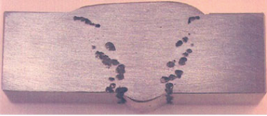
This corrosion is catalysed chiefly by chloride ions (Cl⁻), very common in seawater, in the sugar and ethanol industry (juice and molasses) and in chemical process industries.
The PREN calculation: how is resistance measured?
To estimate the theoretical resistance of a stainless steel to pitting corrosion, metallurgy uses the PREN index (Pitting Resistance Equivalent Number), calculated from the chemical composition of the material by the equation:
PREN = %Cr + 3.3 × (%Mo + 0.5 × %W) + 16 × %N
- Common austenitic stainless AISI 304L has a PREN of only ~18, making it unsuitable for aggressive chloride-bearing environments.
- Lean Duplex S32101 reaches a PREN of ~26. Despite its low nickel content and almost no molybdenum, its high chromium (21.5%) and nitrogen (0.22%) content compensates for that absence, giving pitting corrosion resistance far superior to 304L and comparable to AISI 316L.
The chemical test to ASTM A1084
Welding exposes duplex steel to extreme temperatures, which can cause localised chromium and nitrogen depletion (sensitisation) in the Heat Affected Zone (HAZ) or in the weld metal. To assess whether welding has reduced the chemical resistance of the assembly, a corrosion test to ASTM A1084 (Method A) is carried out.
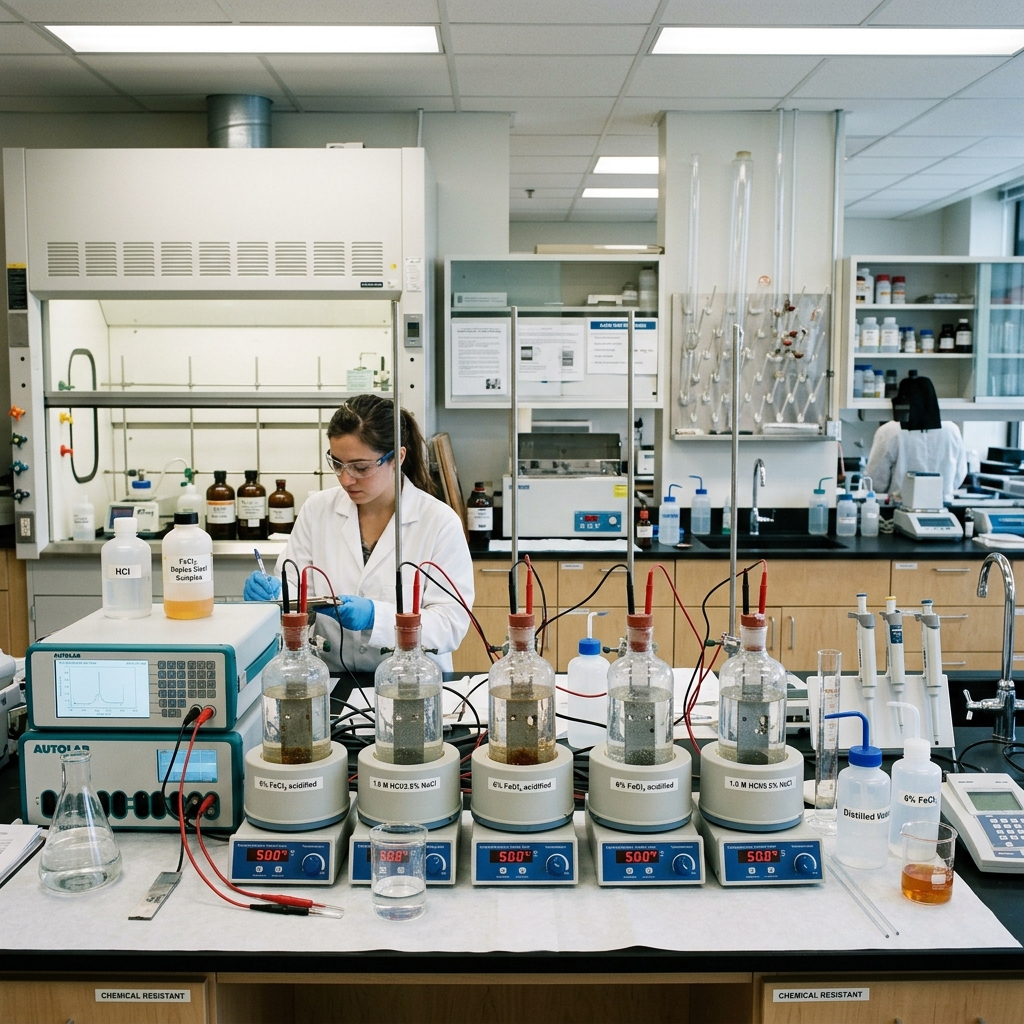
Below is a photograph of the sample positioning rig in the thermostatically controlled chemical bath used in our study:
Test procedure:
- Samples from the butt welded joints (GTAW and GTAW-DF) are carefully cut and polished.
- The specimens are weighed on a high-precision analytical balance.
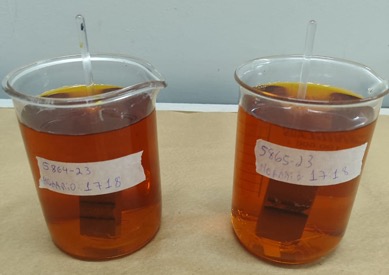
- The samples are immersed in an aggressive acidified ferric chloride (FeCl₃) solution at a controlled temperature of 25 °C for 24 hours.
- After the test, the samples are cleaned, examined under a microscope for pits, and reweighed to determine the mass loss.
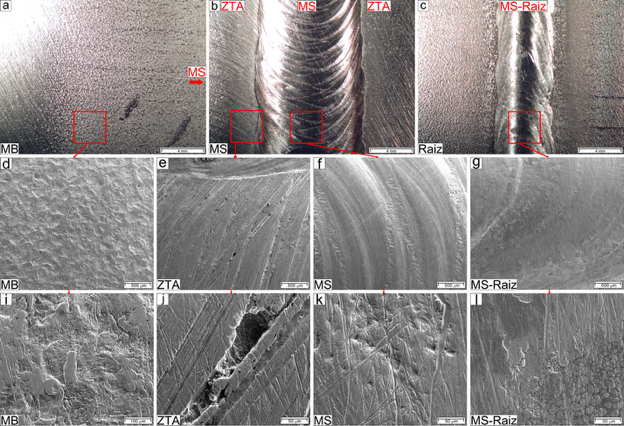
Below we can compare the detailed stereomicroscopy and electron microscopy (SEM/EDS) analysis of the surface condition of the butt joints after the pitting corrosion test.
First, with the conventional TIG process (GTAW), we see clear pit initiation sites associated with precipitates in the HAZ:
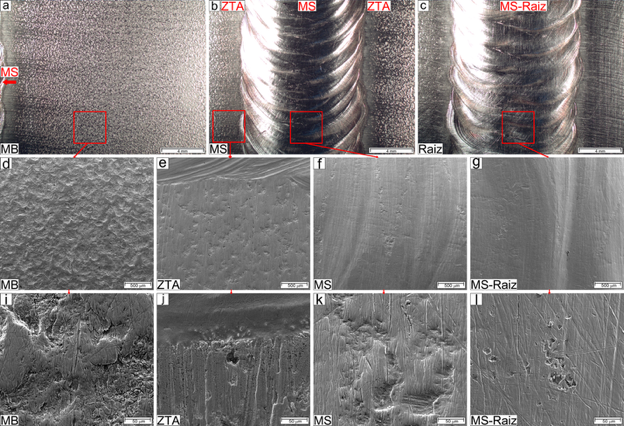
And, by contrast, with the Double-Sided TIG process (GTAW-DF), where the surface remained practically free of corrosive attack, indicating that the duplex alloy’s passive layer was preserved:
Comparative results: GTAW vs GTAW-DF
The chemical tests on Lean Duplex S32101 samples produced results of real importance for corrosion engineering:
- Minimal mass loss: both welded joints showed extremely low mass loss rates, far below the rejection limit set by the standard.
- HAZ behaviour: although the Double-Sided TIG process (GTAW-DF) involves a second welding arc on the root side (which in theory would increase time at high temperature), the HAZ showed no loss of corrosion resistance. This is because controlled cooling and continuous gas shielding on both sides of the plate prevented severe chromium nitride precipitation.
- Protected weld metal: the use of ER2209 consumable ensured the weld metal was metallurgically enriched, making it the most corrosion-resistant region of the assembly.
Relevance in materials engineering
Chemical testing to ASTM A1084 shows that the Double-Sided TIG process (GTAW-DF) is entirely viable and safe for fabricating equipment in Lean Duplex S32101 steel.
The welded joint retains the chemical integrity of the passive layer, ensuring that tanks, evaporators and industrial piping exposed to chloride-bearing corrosive media operate for many years with very little maintenance and no risk of premature pitting failure.