
July 07, 2026
Double-Sided TIG (GTAW-DF) vs conventional TIG: what is the real thermal impact on joint properties?
The thermal physics of welding
Welding is essentially a process of highly intense, localised heat transfer. The way heat is introduced into the joint (heat input) and the speed at which the joint cools (cooling rate, commonly measured by the t8/5 time - the cooling time from 800 °C to 500 °C) govern the entire final microstructure of the weld bead and of the Heat Affected Zone (HAZ).
In duplex stainless steels, thermal control is even more critical. If cooling is too fast, ferrite has no time to transform into austenite, producing an excessively ferritic and brittle joint. If cooling is too slow (high heat input), there is a risk of deleterious phase precipitation and loss of mechanical and corrosion properties.
The Double-Sided TIG process (GTAW-DF)
The Double-Sided TIG process (GTAW-DF), also known as synchronised twin-torch TIG welding, uses two torches welding simultaneously at the same point of the joint but on opposite sides of the plate.
- Torch 1 (face) performs the heterogeneous weld (with filler metal).
- Torch 2 (root) performs an autogenous weld (no filler metal), also serving as active protection against oxidation.
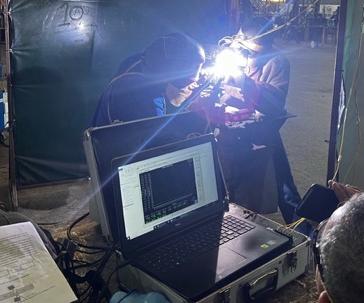
The image below shows the actual welding trial using the Double-Sided TIG technique (GTAW-DF) on our test bench:
Because two arcs are open at the same time, a common question arises among engineers and inspectors: will this process cause overheating that damages the metallurgical properties of duplex steel?
Comparative analysis of heat input and reliability
Thermal studies using thermocouples on 6 mm butt joints in Lean Duplex S32101 revealed very interesting behaviour when comparing conventional TIG (multiple passes with a V-groove) with Double-Sided TIG (single pass, no groove):
- Equivalent heat input: although the GTAW-DF process runs two simultaneous arcs, the absence of a groove allows the 6 mm plate to be welded in a single pass and at a significantly higher travel speed. The resulting heat input per unit length ends up very well distributed, keeping cooling rates entirely suitable for austenite formation.
- Defects and discontinuities (radiography): conventional TIG (GTAW) showed greater sensitivity to operational discontinuities in radiographic testing, recording porosity in the root because of the welder’s restricted access. The GTAW-DF process, by contrast, showed complete fusion and no volumetric porosity, achieving full acceptance in NDT.
Below are the digitised radiographic films from our study: the two upper strips (a and b) are conventional TIG with small localised discontinuities in the root, while the two lower strips (c and d) show the excellent uniformity and soundness of the Double-Sided TIG process (GTAW-DF):

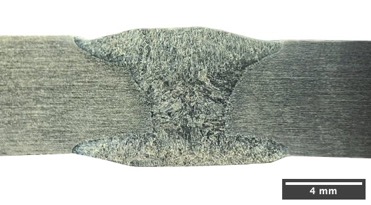
Beyond radiography, macrographic metallographic analysis confirms the geometric soundness of the welds. Below is the cross-section obtained with conventional TIG (showing multiple passes and a greater number of thermal interfaces):
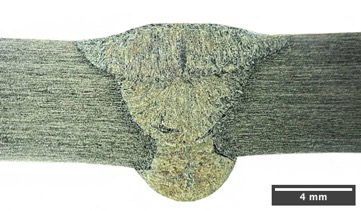
And, in contrast, the cross-section of the joint welded in a single pass by the Double-Sided TIG process (GTAW-DF), with excellent penetration and a symmetric profile:
Technical conclusion
Double-Sided TIG welding (GTAW-DF) has proven to be a highly reliable process for joining Lean Duplex S32101 plate. The twin arc optimises weld penetration and root gas shielding synchronously.
Although it requires greater operational coordination (two welders or synchronised automated heads), the productivity gains (single pass, no groove) and the elimination of root discontinuities make it an engineering choice that is markedly superior to the conventional method.