
April 27, 2026
Far beyond the weld bead: 10 reasons to have a Level 2 welding inspector consulting for your company
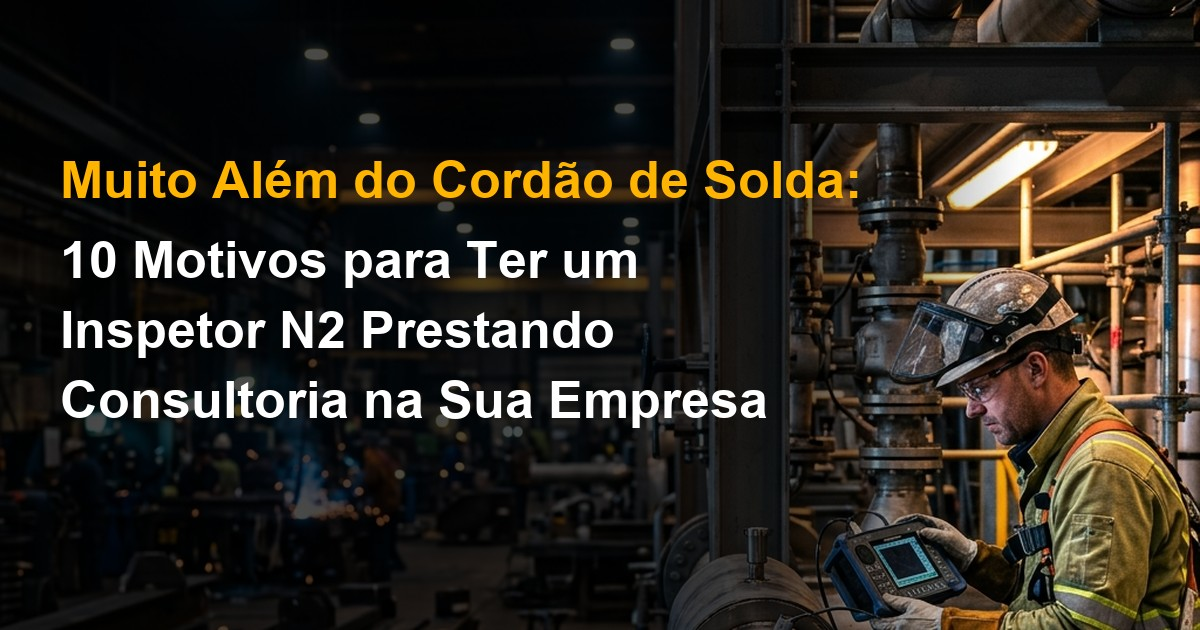
In day-to-day industry, welding is usually seen as just another production step. The arc strikes, the metal melts and the part moves on. The reality is that what decides whether a project makes money or loses it happens long before the welder lowers the hood.
Engineering decisions, contract review, material selection and code compliance change the game. It is exactly in that context that having a Level 2 Welding Inspector acting as a consultant stops being technical over-refinement and becomes a business strategy.
Whether in a small fabrication shop or on a large industrial erection site, here are 10 direct impacts of that specialist support:
1. The end of the hidden cost of rework
Patching up mistakes is expensive. And not just the weld repair: scrapped material, unproductive hours, extra consumable consumption, electricity, and worst of all, late delivery. Consulting works on prevention: adjusting parameters and processes so the mistake never happens.
2. Quality that protects your product’s reputation
Meeting demanding codes (ASME, AWS, ISO, Petrobras, DNV) is not box-ticking, it is making sure the equipment will not fail in the field. Well-executed inspection sharply reduces rejection rates at the end client and raises the reliability of what your plant delivers.
3. Procedure and welder qualification without the headache
Writing and getting approval for a WPS, a PQR and qualifying your team are bureaucratic and technical steps. A specialist takes care of that, guaranteeing full compliance and expanding your company’s capacity to take on more complex work without getting stuck on documentation.
4. Real reduction in fabrication cost
Optimisation is not about using the cheapest consumable, it is about using the smartest process. Reviewing joints, choosing the right process or adjusting one parameter can halve welding time. The financial return on consulting usually shows up in the first weeks.
5. Preventing losses on badly assessed contracts
This is where profit usually leaks away. Accepting a contract without a deep critical review can hide very expensive traps: specific laboratory testing (impact, corrosion), heat treatments (PWHT), special raw material requirements (PMI) and third-party inspection. An experienced inspector maps those risks before signature, protecting your margin.
6. Rigorous control of incoming material
A fundamental benefit, and a badly neglected one. What good is an excellent welder if the base metal or the consumable arrived out of specification? Technical review of raw material and consumable certificates (MTRs), chemical and mechanical properties, keeps unsuitable material out of your production line and off the final inspection reject list.
7. Peace of mind in client audits and inspections
When the end client or a certifying body walks into the plant, improvisation has no place. Technical support during hold points, witnessed tests and audits allows a conversation on equal terms with the client’s inspectors, projecting confidence and speeding up releases.
8. Databooks and documentation approved first time
The job does not end when the weld cools; it ends when the databook is signed. Structuring weld maps, inspection records, ITPs and fabrication dossiers in a traceable, organised way avoids payments being held back over documentation.
9. Failure investigation (root cause analysis)
Recurring cracks, constant porosity or repeated ultrasonic rejections? Consulting does not just point out the defect; it applies engineering judgement to investigate the root cause - metallurgical, human or equipment-related - and solves the problem for good.
10. Raising the technical level of the team, and competitiveness
Having a specialist on site transforms the culture of a plant. Welders and supervisors start to understand the “why” behind each procedure. With the process under control and a sharp team, your company gains the technical headroom to compete for larger contracts and more demanding clients.
In short: inspection is not a cost, it is a strategy.
Many companies only look for welding and engineering support once the problem has already blown up and the job is at a standstill. The real value of specialist consulting lies in anticipation and risk management. It protects quality, it protects your margin and, above all, it protects your company’s name in the market.
Does your company need to improve welding quality and structure its technical documentation? Get in touch and let’s talk about how consulting can help on your next project.