
July 08, 2025
ASME IX 2025: the main changes affecting welding qualifications
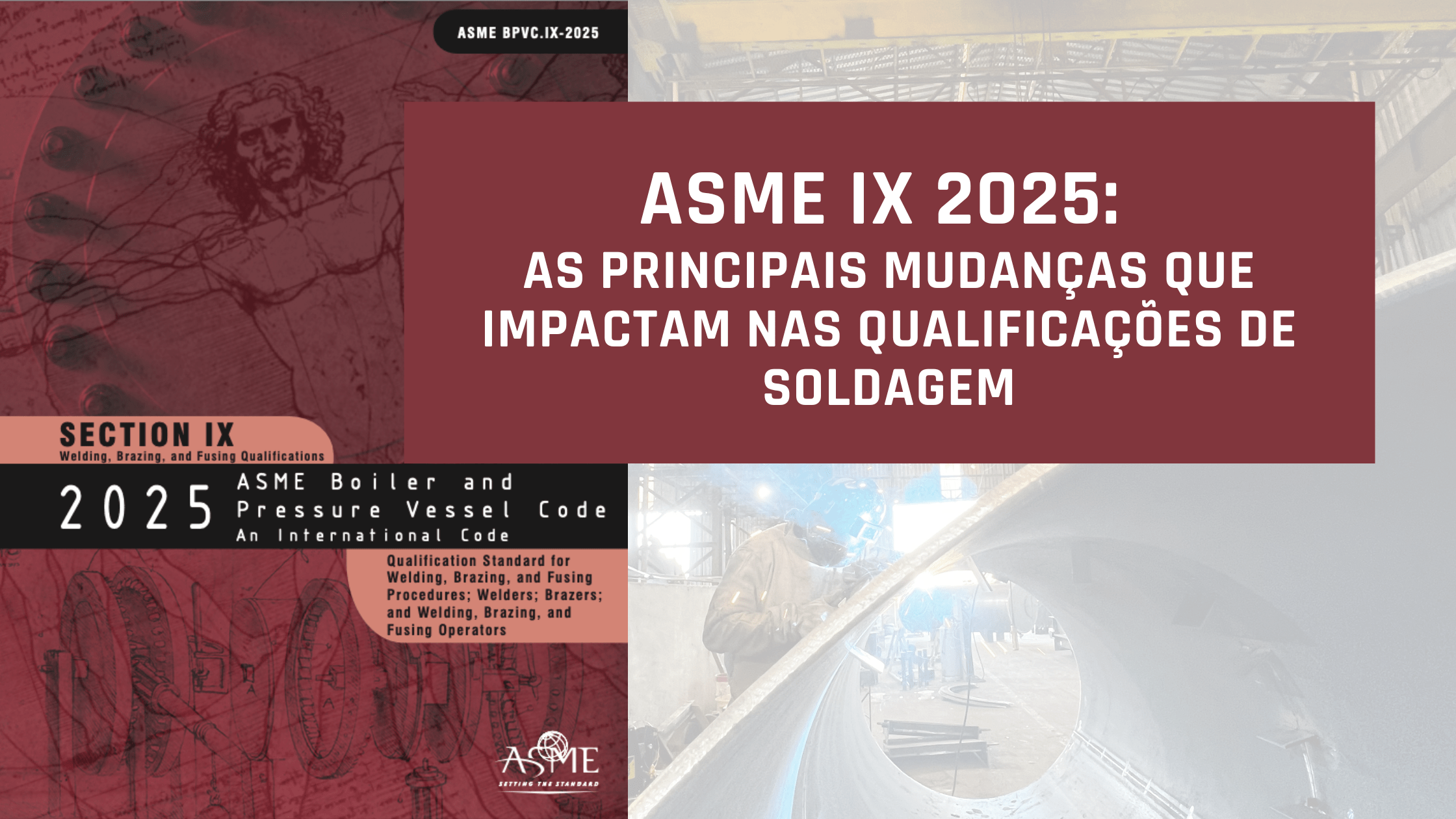
The 2025 edition of ASME Section IX was published on 1 July and becomes mandatory from January 2026. After a detailed review of the “Summary of Changes” in the new edition, I read and compared it item by item against the previous edition. This article presents the welding-related points that changed most, and that therefore demand attention from professionals working with procedure, welder and operator qualification.
QW-202.2 - Qualified thickness of base and weld metals
- The generic reference to QW-451 has been removed.
- Users must now check the specific variable tables for each process.
- The change was driven by inconsistencies for special processes such as EBW, LBW, FW and DW.
New supplementary essential variable (where impact requirements apply) for the SMAW, SAW, GMAW, FCAW, GTAW, PAW and LLBW processes:
QW-410.92 - Limits the heat input calculation for weave passes to a bead width of up to 25 mm.
- Above that width, heat input must be calculated on the actual distance travelled by the electrode, taking the weaving path into account.
- That increases the distance travelled in the same time interval, reducing the qualified heat input.
- It directly affects WPSs/PQRs qualified with bead widths above 25 mm.
Table QW-260 - EBW process
- Variable QW-403.15 has been moved from the essential variable column to the supplementary essential column (where impact requirements apply).
QW-284
- P-Number 54 added.
Table QW-453
- Qualification information for WPS and performance by corrosion-resistant overlay has been grouped separately from hardfacing.
- Variables for welding operators added.
QW-403.16 - Application to tubesheet qualification
- Previously it limited both increases and decreases in diameter.
- It now limits only decreases in diameter, making the criterion more flexible.
P-Numbers revised and added
- P-54 and P-81 added.
- As a result, many variables referring to P-Numbers were revised.
New variables:
- QW-410.91 - affects the LBW process for hardfacing.
- QW-410.93 - affects the GMAW process for additive manufacturing (QW-600).
QW-421.1(a)
- The reference to looking up P-Numbers on the pnumbers.org website has been removed.
Table QW/QB-422 - P-Numbers
- The ferrous and non-ferrous alloy tables have been merged.
- Additional detail on API 5L base metals: grades with the “L” prefix (e.g. L450) are now equivalent to those with the “X” prefix (e.g. X65).
Relevant additions:
- P-54: Titanium Grade 38 (Ti-4Al-2.5V-1.5Fe).
- P-81: Cobalt alloy R31233 (previously P-49, now removed).
QW-423 - Qualification range for welders
- Welders qualified in P-No. 81 are now qualified for the whole family of metals as updated (P-No. 1 to 15F, 34, 41-46, 81), provided a nickel- or cobalt-based consumable is used.
Table QW-432
- Consumable SFA-5.14 ERNiCr-8 added to F-Number 43.
Table QW-461.0
- Qualification on plate in 1G now also qualifies fillet welds in the horizontal position.
- This makes qualification easier for submerged arc welding (SAW), which previously required 1G + 2F for horizontal fillets.
Figure QW-462.5(a)
- Previously, minimum thickness was established from the distance between the base metal interface and the weld finished surface.
- It can now also be established from the distance between the fusion face and the finished surface.
- The reference used must be described in the WPS/PQR.
Non-mandatory Appendix M - Welding of duplex stainless steel
A new appendix has been added with specific guidance for welding duplex stainless steels, setting out metallurgical precautions and additional qualification requirements. I personally agree with it: this steel is highly susceptible to the formation of deleterious phases that can cause catastrophic damage if welded incorrectly, and ASME had treated it with little rigour. It is now better aligned with the requirements of Petrobras N-133 and NORSOK M-601.
Bear in mind that it is a non-mandatory appendix and applies only where required by other sections. Reviewing ASME VIII Div. 1 ed. 2025, it is not being invoked there; I have not assessed the other codes. Keep an eye on future editions.
Classification of duplex steels (based on PREN):
- Lean: PREN < 30.0 Examples: UNS S32101, S32202, S32304, S32003, S82011, S82441
- Standard (conventional): 30.0 ≤ PREN < 40.0 Examples: UNS S31803, S32205, S32550, J92205, J93372
- Super: 40.0 ≤ PREN < 48.0 Examples: UNS S32520, S32750, S32760, S32906, J93380, J93404
- Hyper: PREN ≥ 48.0 Examples: UNS S32707, S33207
PREN formula: %Cr + 3.3(%Mo + 0.5%W) + 16 × %N
Additional testing for duplex qualification:
- Ferrite balance between 30% and 65%, measured to ASTM E562 in the weld and the HAZ.
- Charpy testing:
- ASTM A923 Method B for standard and super duplex.
- ASTM A1084 for lean duplex.
- Objective: to check for the presence of brittle intermetallic phases.
Additional essential variables for duplex:
- Narrower heat input range:
- It may not be lower than the minimum average, nor higher than the maximum average.
- Requires one test coupon at minimum heat input and another at maximum heat input.
- Narrower preheat range:
- Minimum of 10 °C and a variation of ±28 °C from the qualified temperature.
- Interpass temperature:
- Minimum and maximum limits. Maximum of 177 °C and a variation of ±28 °C from the qualified temperature.
- Changes to shielding and purge gas composition.
- Significant restriction on the qualified base metal and deposit thickness range.
Additional requirements for welder qualification on duplex:
- The welder must be qualified in the same class of duplex used on the job.
- Ferrite balance testing is recommended as part of welder qualification.
Issuing or revising a WPS to the 2025 edition?
Download our free WPS template in Excel to ASME IX 2025 ed. - bilingual, with every QW-402 to QW-410 block and a worked GTAW + FCAW example.
And if you want to master the complete process, from the P-Number to the PQR and the databook documents, take a look at the course Writing a WPS - ASME IX (2025 ed.). People on the priority list hear about the class opening first.