
April 08, 2025
Fillet welds: why planning their execution avoids rework and excessive cost
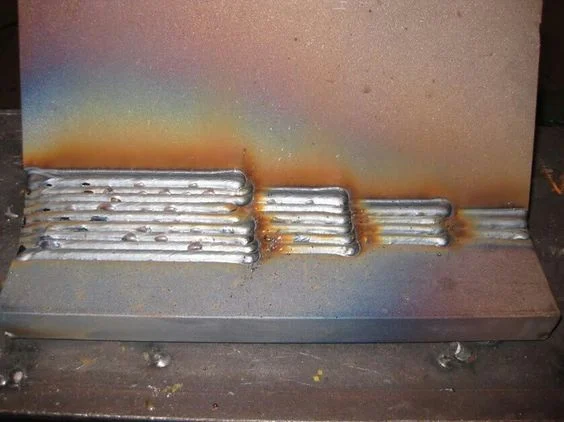
Welding is fundamental in countless industries, and the fillet weld, used to join parts at an angle, is one of the most common techniques. Its apparent simplicity is deceptive: correct execution, and in particular planning the pass sequence and setting the size, has a profound impact on structural integrity, efficiency and project cost.
This article looks at fillet welds, the crucial importance of the deposition sequence, and the significant cost difference caused by a minimal increase in size, using the example of 5 mm versus 7 mm.
Understanding the fillet weld
A fillet weld joins two surfaces at an angle (as in T-joints or corner joints), forming a roughly triangular cross-section. Its key elements are:
- Leg: the nominal dimension of the fillet, measured from the root to the face on each part.
- Throat: the shortest distance from the root to the face, critical to strength.
Fillets are essential in steel structures, ships, vehicles, machinery and many other applications, transferring loads and ensuring structural continuity.
Why the pass sequence matters
A small fillet (say 3-5 mm) can be welded in a single pass. As the size increases, however, trying to deposit all the material at once causes serious problems:
- Distortion: excessive localised heat deforms the parts.
- Residual stress: high internal stresses can lead to cracking and reduce service life.
- Metallurgical quality: inadequate cooling can produce brittle microstructures in the weld and in the Heat Affected Zone (HAZ).
- Defects: difficulty controlling the weld pool, especially out of the flat position, leads to undercut, lack of fusion and similar defects.
To avoid this, larger fillets are welded in multiple passes, controlling heat input and securing quality. A common approach, though it can vary with codes and processes, is:
- Root pass: ensures penetration and fusion at the base of the joint.
- Fill passes: build the volume of weld metal over the root.
- Cap pass: completes the dimension and produces a smooth profile.
Common guidelines for pass sequence:
- Fillets ≤ 7 mm: frequently a single pass. Efficient, but demands control as you approach the 7 mm limit.
- Fillets of 8 mm to 11 mm: typically 1 root pass plus 2 subsequent passes. Splits the heat and improves control. Requires interpass cleaning where applicable.
- Fillets of 11 mm to 15 mm: need more passes, such as 1 root + 2 fill + 3 cap (or similar). Complexity increases in managing heat and geometry.
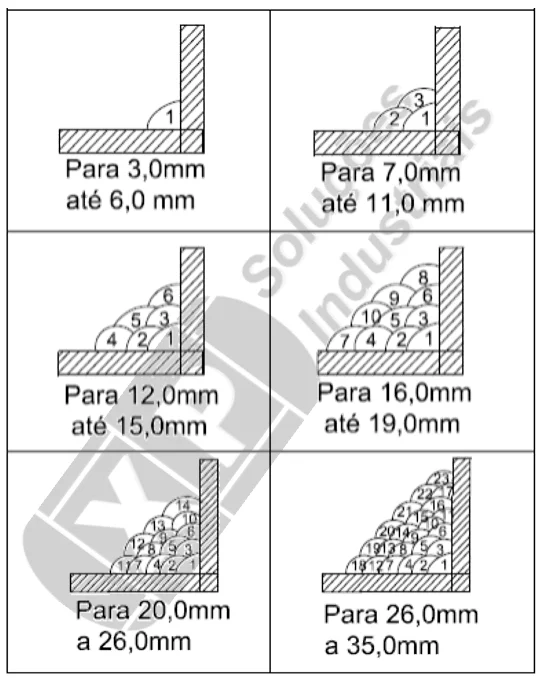
Every additional pass increases welding time, cleaning time and material consumption. The Welding Procedure Specification (WPS) defines the exact details for each application.
The hidden cost: why does 7 mm cost so much more than 5 mm?
An increase of only 2 mm in the fillet leg looks small, but the impact on cost is disproportionate. The reason is the volume of weld metal required. The cross-sectional area (A) of a triangular fillet is approximately:
A ≈ (leg)² / 2
Calculating for our examples:
- 5 mm fillet: A₅ ≈ (5)² / 2 = 12.5 mm²
- 7 mm fillet: A₇ ≈ (7)² / 2 = 24.5 mm²
The percentage increase in weld metal volume is:
Increase % = [(24.5 - 12.5) / 12.5] * 100% = 96%
A 40% increase in the linear size of the leg produces almost a 100% increase in weld volume.
That feeds straight through into cost:
- Consumable cost (wire/electrode, gas): almost doubles. Cost is directly proportional to the volume deposited.
- Labour cost: increases significantly.
- Depositing almost twice the material takes longer, even in a single pass (travel speed is lower for 7 mm).
- If the 7 mm fillet requires multiple passes (per the guidelines for larger fillets or specific requirements), labour time (welding plus interpass cleaning) jumps, potentially tripling or more relative to a single pass.
- Energy cost: more arc time means more consumption.
- Indirect costs: greater risk of distortion (and the cost of correction/rework), lower overall productivity.
Quantifying the increase:
Taking double the consumables and the substantial (or drastic, if multi-pass) increase in labour time, the total cost of a 7 mm fillet can easily be 70% to 150% higher than a 5 mm fillet. The increase is not linear; it is amplified by volume and by working time.
Optimisation is the key: do not oversize.
This example shows why oversizing welds “to be safe” is financially damaging. Fillet size should be determined by engineering calculation to meet the strength requirements of the applicable code.
Specifying the minimum size needed, and making sure fabrication uses efficient procedures and the correct pass sequence, is crucial to controlling cost without compromising quality. Collaboration between design and production is fundamental.
Conclusion
A fillet weld is more than a simple join; it is an engineering component where planning and precision are essential. The right pass sequence secures quality and controls problems such as distortion. The cost analysis between 5 mm and 7 mm fillets shows how small dimensional changes can blow up cost through the exponential increase in weld volume and labour time.
Sizing correctly on the basis of engineering, planning execution and avoiding unnecessary oversizing are vital practices for the efficiency, quality and economic viability of any welded project.