
July 13, 2024
Which welding process costs your company more? A comparison: MIG/MAG vs stick welding
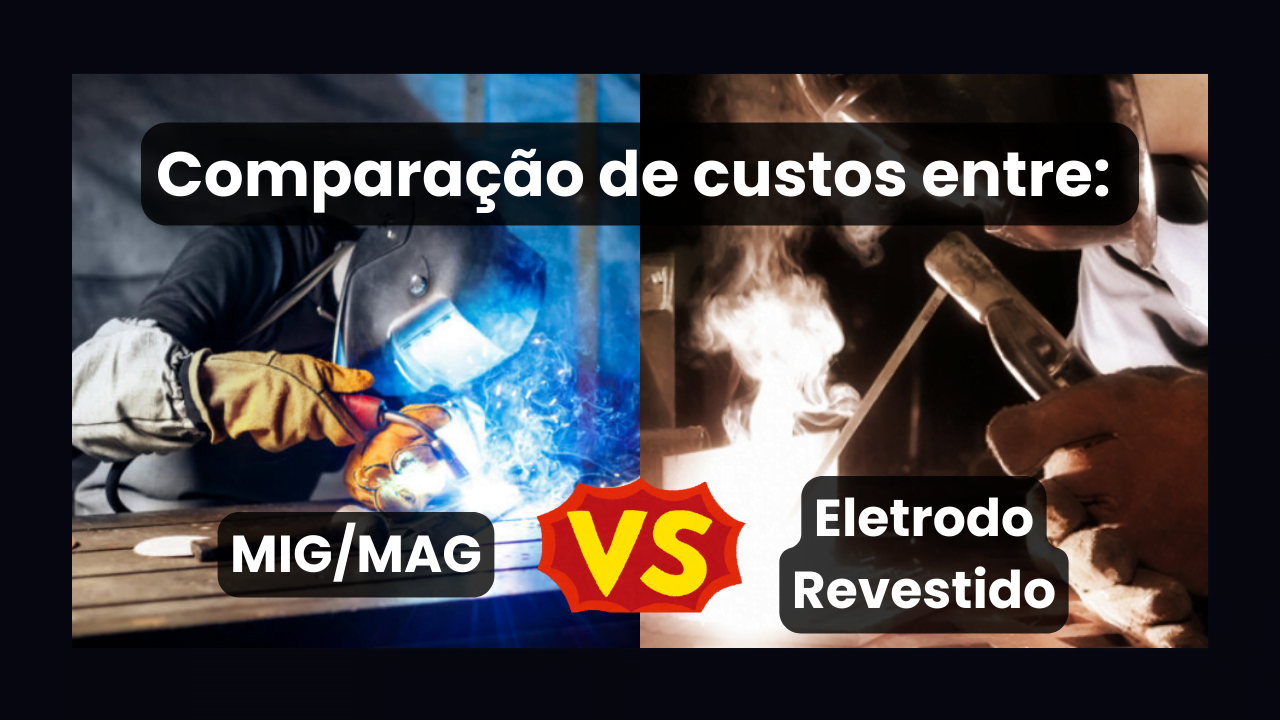
Choosing the right welding process is fundamental to operational efficiency and to the financial health of the company. Today we will look at two popular methods, MIG/MAG (solid wire) and stick welding (SMAW), evaluating not only the up-front cost but also the operating cost and the impact on productivity.
All figures below are in Brazilian reais (BRL).
Process 1: MIG/MAG (solid wire)
Details:
Cost of the welding machine plus fixtures: BRL 150,000.00
Process time: 8 hours
Cost analysis:
Machine and fixture depreciation cost per part:

(Assuming 5 years of use, 180 hours per month)
Total cost for 8 hours of production = 13.88 x 8 = BRL 111 per part
Operating cost (labour, energy, consumables, etc.):
The total cost of the operator, energy, consumables, rent and operating expenses apportioned per hour worked. For the purposes of this calculation we will use BRL 100.00 per hour.
So: 100 x 8 hours = BRL 800.00 per part
Total cost per part:
Depreciation cost + operating cost: 111 + 800 = BRL 911.00
Over 5 years, with one machine, it is possible to produce:

At a selling price of BRL 2,000 that gives total revenue of BRL 2,700,000 and a total profit of BRL 1,470,000.
Process 2: Stick welding (SMAW)
Details:
Cost of the welding machine: BRL 5,000.00
Process time: 24 hours
Cost analysis:
Machine and fixture depreciation cost per part:
Depreciation =

(Assuming 5 years of use, 180 hours per month)
Total cost for 24 hours of production = 0.46 x 24 = BRL 11 per part
Operating cost (labour, energy, consumables, etc.):
The total cost of the operator, energy, consumables, rent and operating expenses apportioned per hour worked. For the purposes of this calculation we will use BRL 100.00 per hour.
So: 100 x 24 hours = BRL 2,400.00 per part
Total cost per part:
Depreciation cost + operating cost: 11 + 2,400 = BRL 2,411
Over 5 years, with one machine, it is possible to produce:

At the same selling price of BRL 2,000 that gives total revenue of BRL 900,000 and a total loss of BRL 184,950.
Conclusion
- MIG/MAG (solid wire) has a higher up-front cost, but delivers greater efficiency and lower operating costs, producing a substantial profit over 5 years.
- Stick welding has a very low up-front cost, but the low productivity and low efficiency of the process drive high operating costs which, over time, turn into a loss.
Although the example above is simple, and most companies have long moved beyond stick welding, many of the things that undermine productivity and drain profit remain unexplored. Optimising electrical parameters, travel speed, arc length, the use of fixtures, the sequence of operations, shielding gases, welding positions and the right tooling all offer a wide field for improving output and cutting cost.
For companies focused on long-term efficiency and profitability, continuous optimisation of the welding process is essential. If your company does not have a dedicated process or welding engineering team, our consulting is ready to help.
What we offer:
- Production process mapping: identifying critical points and improvement opportunities.
- Tailored solutions: greater efficiency, productivity and quality at lower cost.
- Welding process selection: choosing the method best suited to your needs.
- Improving the sequence of operations and fixtures: adjustments to maximise performance.
- Specialist training: equipping your team to make effective use of the new solutions.
Get in touch to transform your welding processes and reach a new level of efficiency and profitability.