
July 13, 2024
Which is the best welding process?
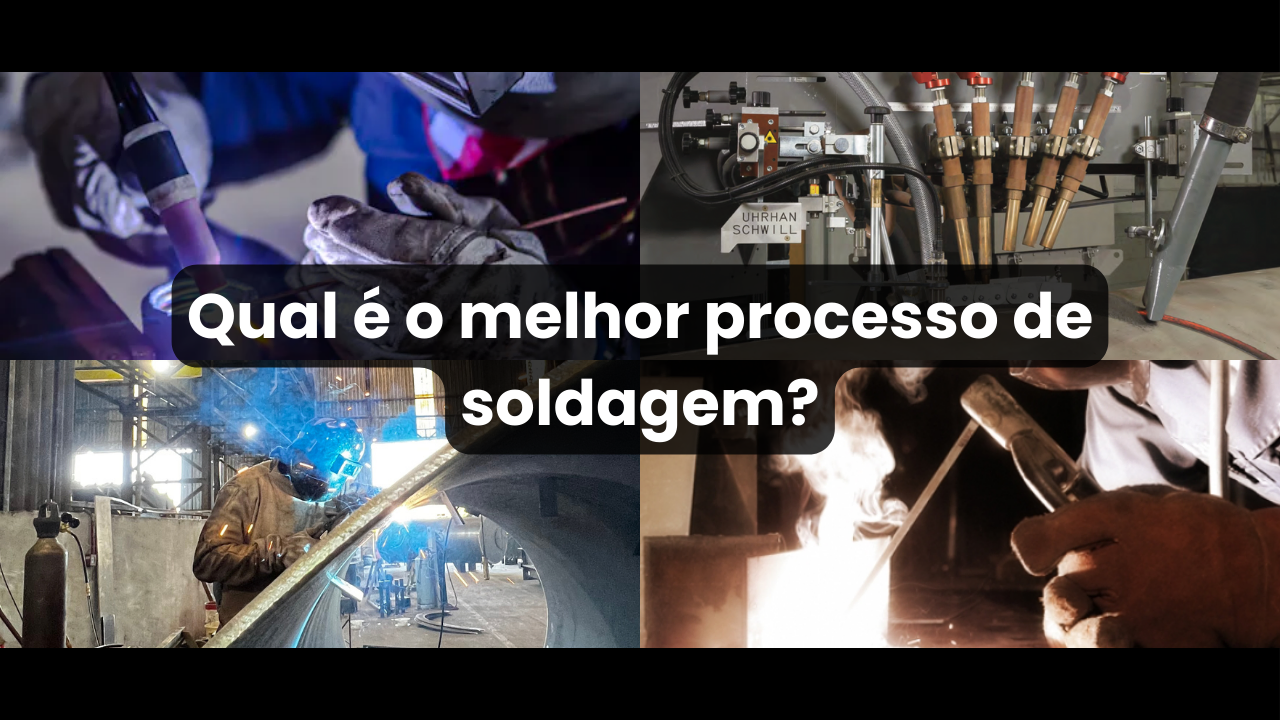
Choosing the best welding process may look like a simple task, but in practice it involves a series of factors that vary with the specific application. From material type through to welding position and production volume, every variable can influence which process is most efficient. In this article we look at the main considerations when choosing a welding process, and compare the main processes in terms of deposition rate and operating factor.
Considerations when choosing a welding process
-
Material type: different materials have properties that suit certain processes better. Carbon and stainless steels, for example, can be welded with a variety of processes, while aluminium may require specific techniques such as AC TIG welding.
-
Welding position: the position of the joint (flat, horizontal, vertical or overhead) directly influences process choice. On pipe in the 5G position, for example, the most suitable processes are manual (TIG and stick); semi-automatic processes (MIG / flux-cored) can also be used but depend heavily on the material, the welder’s skill and parameter setting. Submerged arc is impossible there, since that process only welds flat (1G and 1F) and horizontal fillets (2F).
-
Material thickness: thick joints may need processes with a higher deposition rate to stay efficient, while thin material requires more control to avoid distortion. For example: submerged arc on straight joints in heavy thicknesses and TIG on joints thinner than 6 mm.
-
Production volume: for series production with high repetition, the best option is robotic processes (MIG/MAG) with fixtures specific to the product, greatly increasing welding speed, handling and setup. The acquisition cost of that equipment is very high, but at volume the ROI is fast and easily justified. For one-offs, low volume or made-to-order work, flexibility and precision matter more, and very expensive robotic cells cannot be justified.
-
Environmental conditions: gas-shielded processes (MIG/MAG, TIG, flux-cored, plasma) are unsuitable in open air with wind. To use them there you need a tarpaulin enclosure so wind does not contaminate or blow away the shielding gas from the joint. There are also environments that are inappropriate for welding altogether, such as underwater. In those cases you need stick welding and special protective equipment, either by diving or using a dry chamber - a kind of submersible that clamps onto the pipe and removes all the water so the welder works in a dry environment.
-
Special requirements: every piece of equipment has its own application requirements, some very demanding: corrosive environments, low temperatures (-46 °C), nuclear equipment, oil pipelines and so on. Each of those brings special requirements such as minimum and/or maximum heat input control, low tolerance for discontinuities found in NDT, special consumables and rigorous control of welding parameters (voltage, current and travel speed), which may demand a fully mechanised process with automatic parameter recording. Each such application must be studied thoroughly before a welding process is chosen, and that process must be trained until excellence and high repeatability are achieved, so that problems do not appear during production.
-
Cost: we cannot forget that everything welded is a product to be sold, and we have to be competitive or the company does not survive - so process cost is a relevant factor in a company’s success. Cost also embeds productivity and quality, since we need to fabricate as fast as possible, at the lowest possible cost, with the least rework and with the final quality specified by the client.
To sharpen the cost analysis, we can consider the application characteristics of each welding process, taking into account its deposition rate - the weight of weld metal added to the joint per hour of arc time - and its operating factor - the percentage of the working day the welder can actually keep the arc open, since they have to stop to move from joint to joint, take breaks, change electrodes, change wire, clean the joint, adjust the machine, grind and so on.
The table below compares some of the main welding processes in terms of deposition rate and operating factor, and can serve as a guide when selecting the right process for your application.
| Welding process | Deposition rate (kg/h) | Operating factor (%) |
|---|---|---|
| Stick (SMAW) | 1 - 2 | 5 - 35 |
| Submerged arc (SAW) | 4 - 10 | 25 - 80 |
| MIG/MAG (GMAW) | 2 - 4 | 15 - 60 |
| TIG (GTAW) | 0.5 - 1 | 5 - 35 |
| Flux-cored (FCAW) | 2 - 4 | 15 - 50 |
| Plasma (PAW) | 0.5 - 1 | 5 - 40 |
Summary of each process
- Stick (SMAW): ideal for field welding and repairs. Flexible, but with a lower deposition rate. Covers a wide range of alloys.
- Submerged arc (SAW): suited to straight-line welding and heavy thicknesses. High deposition rate and operating factor.
- MIG/MAG (GMAW): versatile and efficient in a range of positions. Good deposition rate. Can also be robotised and used on production lines for series products.
- TIG (GTAW): used where high precision and appearance are required, and for thicknesses under 6 mm. Lower deposition rate and moderate cost. Ideal for pipe root passes and leak-tight equipment.
- Flux-cored (FCAW): high deposition rate, better electrical efficiency than MIG/MAG, applicable at all thicknesses, ideal in the flat and horizontal positions.
- Plasma (PAW): similar to TIG but with greater energy concentration. Suited to thicknesses under 6 mm and to mechanised work.
Conclusion
There is no single best welding process; there is the process best suited to each situation. The ideal choice depends on the specifics of the project. You have to assess the needs in terms of material, position, thickness, production volume, environmental conditions, special requirements and cost, which will guide you to the most appropriate process. The comparison table of deposition rate and operating factor can serve as a starting guide, but practical experience and application-specific trials are fundamental to optimising the choice.
We hope this article has given you a clear view of how to choose the best welding process for your needs. If you have further questions or need specialist consulting, do get in touch.