
July 12, 2024
How to choose the right welding machine for industrial use

How do you select the right welding machine for the specific needs of your industrial production? This guide covers everything from machine types and their applications through to cost evaluation and integration with automated systems. Make sure your operation is efficient, high quality and safe with the specialist guidance below.
The first step is to assess what your application actually needs:
- Material type: identify the predominant materials to be welded (steel, aluminium, stainless steel and so on). This influences the choice of current type (AC or DC), the electrical parameters and the welding energy/heat input. For example, duplex steel needs controlled heat input, so a pulsed-arc MIG/MAG process makes sense.
- Material thickness: check the common thicknesses to make sure the machine can handle them. The thicker the material, the higher the welding current and voltage required, because thickness makes the weld pool cool very quickly, which can produce defects such as cracking, lack of fusion, lack of penetration and overlap.
- Welding positions: determine which positions will be needed. This can drastically change the process and machine required. For example, a thick pipe welded in 5G can be welded manually with stick or TIG, which needs a lot of welding time, or with automated processes using TIG, MIG/MAG or even flux-cored wire, which is far faster - but the cost of fixtures and machines will be much higher. Depending on volume, ROI in the 12 to 24 month range is achievable.
- Production volume: determine whether welding will be at scale (mass production) or in small batches (custom production), and also what percentage of time (duty cycle) the arc should or can be open during the working period.
- Quality requirements: evaluate the quality requirements of the project, the client’s specifications and the codes applicable to the equipment being welded. Often one specific clause prohibits or discourages the use of a process, or of a variation of a process, you might be considering in production - for example short-circuit MIG/MAG on oil and gas equipment welds. Applications with Charpy impact testing also tend to limit heat input and add controls.
- Budget: how much the company is willing to pay for the solution. The cheapest machine or solution is not always the best value. It is often worth paying 2-3x more for a machine that is guaranteed not to stop a production line for maintenance, rather than buying the cheapest and having monthly stoppages from manufacturing defects or early failure.
With all that analysed, we can fill in the basic requirements for a welding machine:
- Process: MIG/MAG, flux-cored wire, TIG, stick, submerged arc, plasma, etc.
- Electrical characteristics: AC, DC, pulsed, controlled short circuit (RMD/CMT/STT), TIG cold wire, TIG hot wire, etc.
- Welding current (amps): 100, 200, 300, 500, 1000, 1500, etc.
- Welding voltage (volts): 10, 20, 30, 40, etc.
- Duty cycle: 10%, 60%, 100%
- Electrode/consumable diameter (mm): 0.8, 0.9, 1.0, 1.2, 1.6, 2.0, 2.4, 3.2, 4.0, 5.0, 6.0, etc.
- Number of electrodes/consumables: single, 2, 3, 4, 5, etc.
- Automation/fixturing: none, semi-automatic wire feed, part rotation fixture, robotic arm, robotic cell, collaborative robot, welding positioner, tractor unit, orbital system, etc.
Once those needs are set out, you have to choose which machine to buy. Consider the brands you trust most and evaluate the machines against their specifications.
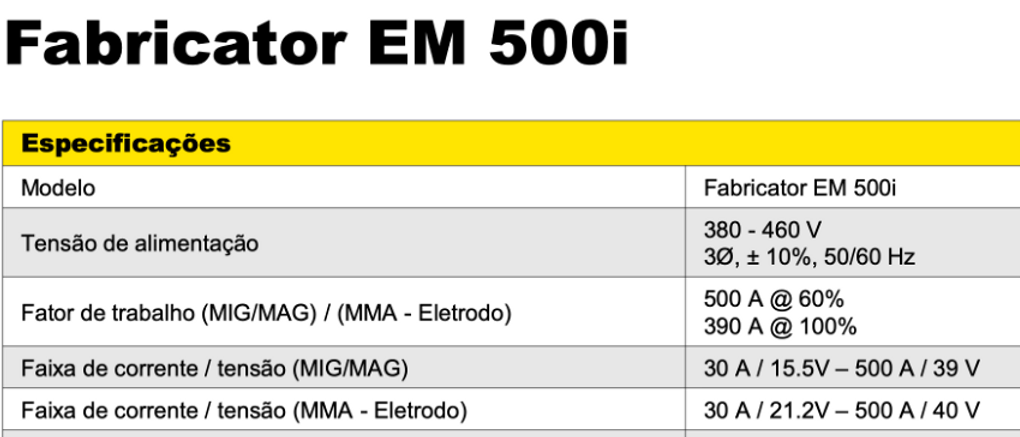
An example of machine specifications:
The machine in the figure below is a MIG/MAG, flux-cored and stick welding machine that can weld at 500 A for 6 uninterrupted minutes, after which it must stop for 4 minutes to cool (60% duty cycle) - but it can also weld at 390 A 100% of the time with no need to stop for cooling.
The machine below, in the same category, holds the same 500 A at 60% duty cycle but reaches 450 A at 100% duty cycle.
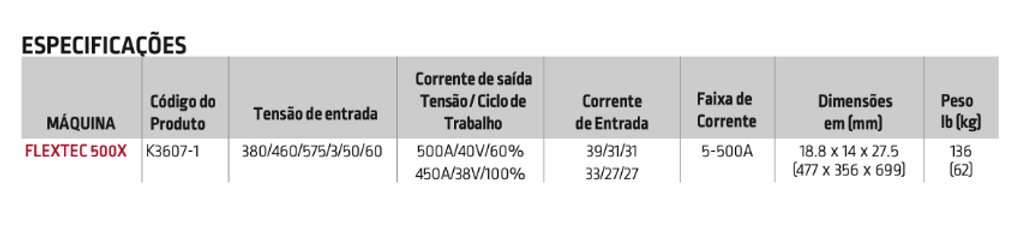
Depending on your needs, the machine in the second figure may be a better fit than the first.
Other factors to consider when selecting the right machine:
Technical support and parts availability
Check whether local technical support and spare parts are available. Fast, effective maintenance minimises downtime and keeps production running.
The manufacturer’s track record
Check whether the manufacturer of the machine you have chosen has good references, or a high rate of manufacturing defects, early and frequent breakdowns, unreliable parameter readouts (low-quality machines show considerable parameter oscillation when analysed with data loggers and similar equipment, which affects final weld quality) and short machine life. All of that can cost companies dearly in the medium to long term if it is not evaluated before purchase.
Conclusion
Choosing the right welding machine is fundamental to optimising production, securing quality and maintaining operational and financial efficiency. By considering machine types, their capabilities, costs and the specific needs of your production, you will be well placed to make an informed choice that brings lasting benefits.